
How far did one outage spread? What you need first is the ‘blast radius’

When one thing stops, everything connected to it can be affected. After a major outage, users and operations teams ask ‘how far did it spread?’ before ‘why?’. This article separates the failure point from the blast radius.
What happened: a large-scale access outage at a global business cloud service
According to news reports, a global business cloud service suffered a large-scale access outage on November 12 (US time). Email, messaging, document collaboration, AI assistants and even security monitoring were affected at the same time, and a large Korean company reportedly sent an urgent notice telling employees that email, collaboration, AI work tools and data analysis tools were unavailable. Connector features of a generative AI vendor linked to the service were also reported to be affected.
This article does not speculate on the cause of the outage or evaluate any company's response. Please refer to each company's official announcements.
The failure point and the blast radius are different questions
When one service stops, the features that depend on it are affected one after another. Operations teams then face two different questions at once.
Where did it start (failure point): Finding the one place that is the cause.
How far did it spread (blast radius): Working out which connected services and users are affected.
Even while the cause is being traced, the people affected need to be told. Without knowing the blast radius, notices are delayed, and delayed notices mean a flood of inquiries.
Why the blast radius is hard to find
Spreading out the system diagram: Teams may find the failure point, yet still have to lay out diagrams to work out how far the affected services extend.
Switching between tools: Metrics are in one place, logs in another and change history somewhere else, so staff move between screens and line up the timing.
Missing what changed just before: A deployment or configuration change right before the failure is often the cause, but its record sits in another system.
AIOps shows the blast radius as a ‘map’ first
AIOps follows the dependencies in your configuration information and shows at a glance the assets affected as the failure spreads through the 1st, 2nd and 3rd stages. It shows the root cause and the affected assets step by step, together with recent change history, similar past incidents and response procedures.
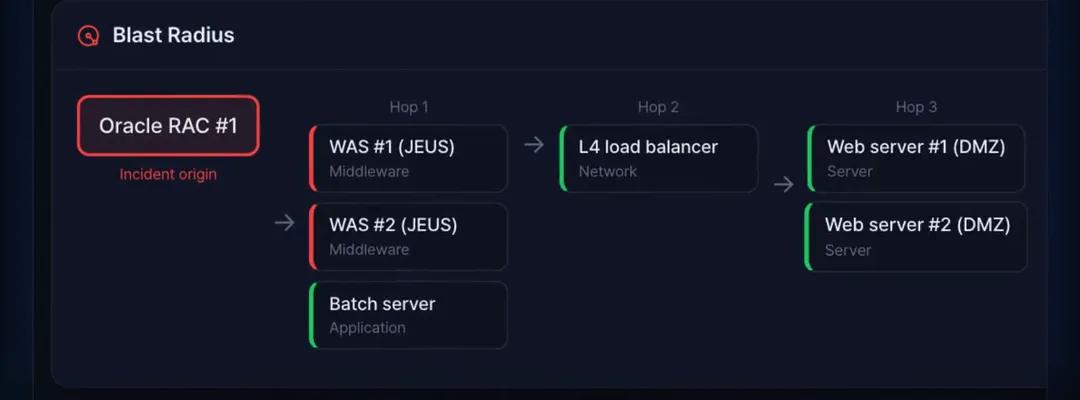
In the product screen example, eight alarms are grouped into one situation, ‘impact spreading to the web service’. It summarizes cause and impact in a single paragraph, for example: a surge in DB sessions spread to two WAS servers and slowed web responses.
Same evidence for whoever is on call: Analysis starts from the same evidence no matter who is on duty.
Notify affected services right away: You can tell the affected services without delay.
Time goes to recovery: The time once spent finding the cause can go to recovery.
Four checks: can you state the blast radius?
Are the connections your services depend on mapped? Check whether dependencies between services and equipment are organized as configuration information.
Can you name the affected services right away when one part stops? See whether you can tell how far it spreads to the 1st and 2nd stages without laying out diagrams.
Is there an order for notifying those affected? Check whether it is decided who tells whom, and in what order.
Is there a fallback for work that depends on outside services? Check whether manual procedures are set in advance for when work that relies on external services, such as email and collaboration tools, stops.
Good to know
This article does not speculate on the cause of the reported outage or evaluate any company's response, and it does not mean any outage can be prevented completely. AIOps makes its judgments from the metrics, logs and configuration information of the infrastructure you operate; it does not analyze failures of an outside vendor's service itself. Actions run only within the scope you approve.
How quickly could your organization state the blast radius of an outage? Use the AI adoption check to review where you stand, or contact us to talk it through.
Sources: Hankyung report (Nov. 13) · Boannews report (Nov. 13)