
AI agents move from ‘experiment’ to ‘production’: companies in Japan now ask ‘does it know our work?’

An AI agent that worked in the PoC. What production asks is whether it knows ‘our work’. In Japan, too, the focus of AI agents is shifting from ‘experiment’ to ‘production’.
What happened: the shift from ‘experiment’ to ‘production’
According to news reports, on November 10 (local time) a global IT company announced a platform for building, running and managing AI agents that perform industry-specific work. It reportedly bundles many build assets with support for control, observability and AI compliance, aimed at regulated industries, and a Japanese IT trade publication covered it on November 12 from the angle of ‘from experiment to production’.
This article does not evaluate that company or its announcement or compare it with any other company; it refers only to the direction of the Japanese market. The article itself is for members only, so only the publicly available summary is cited.
It worked in the PoC. What changes in production?
In a PoC, a few people try the agent and see whether the results look plausible. In production, several departments use it every day, so the questions change. If the ‘permissions and audit’ covered in our previous article is the question of control, this time it is the question of ‘business knowledge’.
Does it produce your company's format? If the output differs from your template, people end up copying it over again.
Is it grounded in your documents and rules? It should build on company guidelines and past materials, not on generic answers.
Who builds it and who uses it? If you need a specialist to build agents before anything starts, it is hard to spread across departments.
Yurika packs your company's templates, documents and work into agent packs
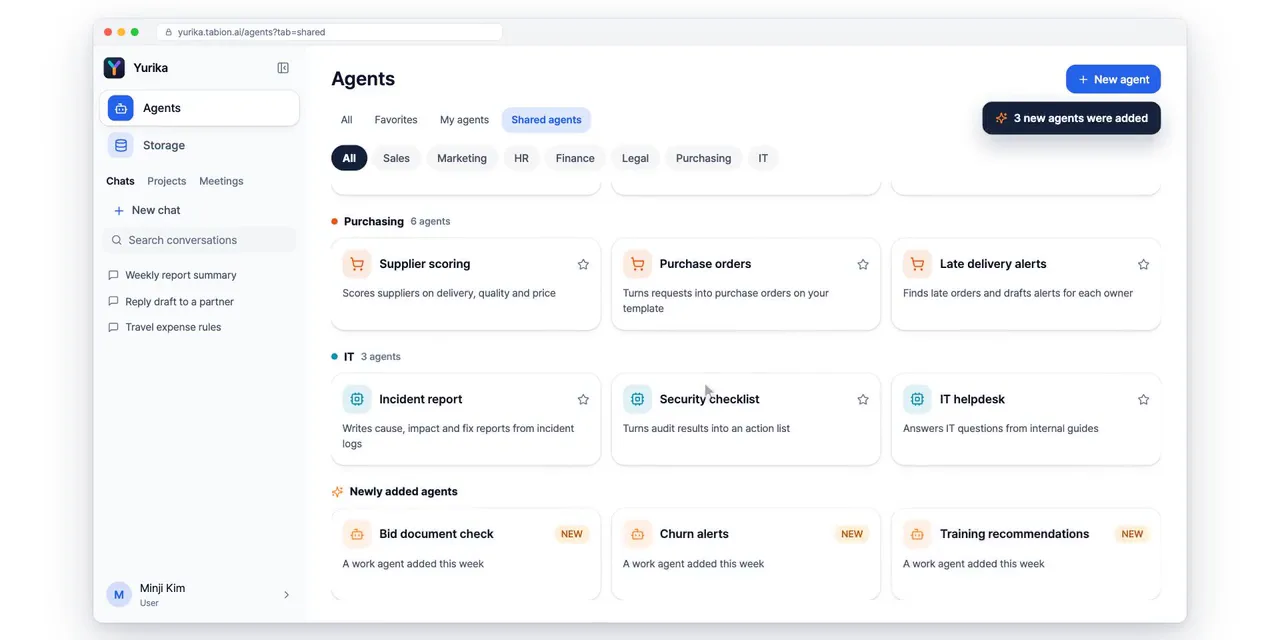
A Yurika agent pack bundles agents, skills and connectors. Adding a pack creates departmental agents, and administrators only fill the storage with the company's templates and reference material.
In your company's format: Agents build from the templates folder and from internal rules and past materials in the reference folder.
Start without specialists: On the day a pack is added, departmental agents appear, and even first-time employees get results by clicking.
Connected to business systems: Connectors link email, file servers and calendars, so results are not copied over by hand.
Four checks before moving to production
Do company templates become the agent's standard? Check whether agents can use report, presentation and official-letter templates as their standard.
Are internal rules and past materials used as grounds? Check whether agents write by referring to rules, guidelines and past materials.
Can the business side start without specialists? Check whether departments can start using agents even without a specialist who builds them.
Do results flow into business systems? See whether results can be passed to email, file servers and calendars without copying them by hand.
Good to know
This article draws on the direction of the Japanese market and does not evaluate or compare the announcement of any specific company. Yurika can start as SaaS without installation, and the business systems to connect and the starting scope are decided together in consultation.
Will your PoC agents still know ‘your work’ in production? Use the AI adoption check to review where you stand, or contact us to talk it through.