
Yurika's three workspaces — how do you choose?
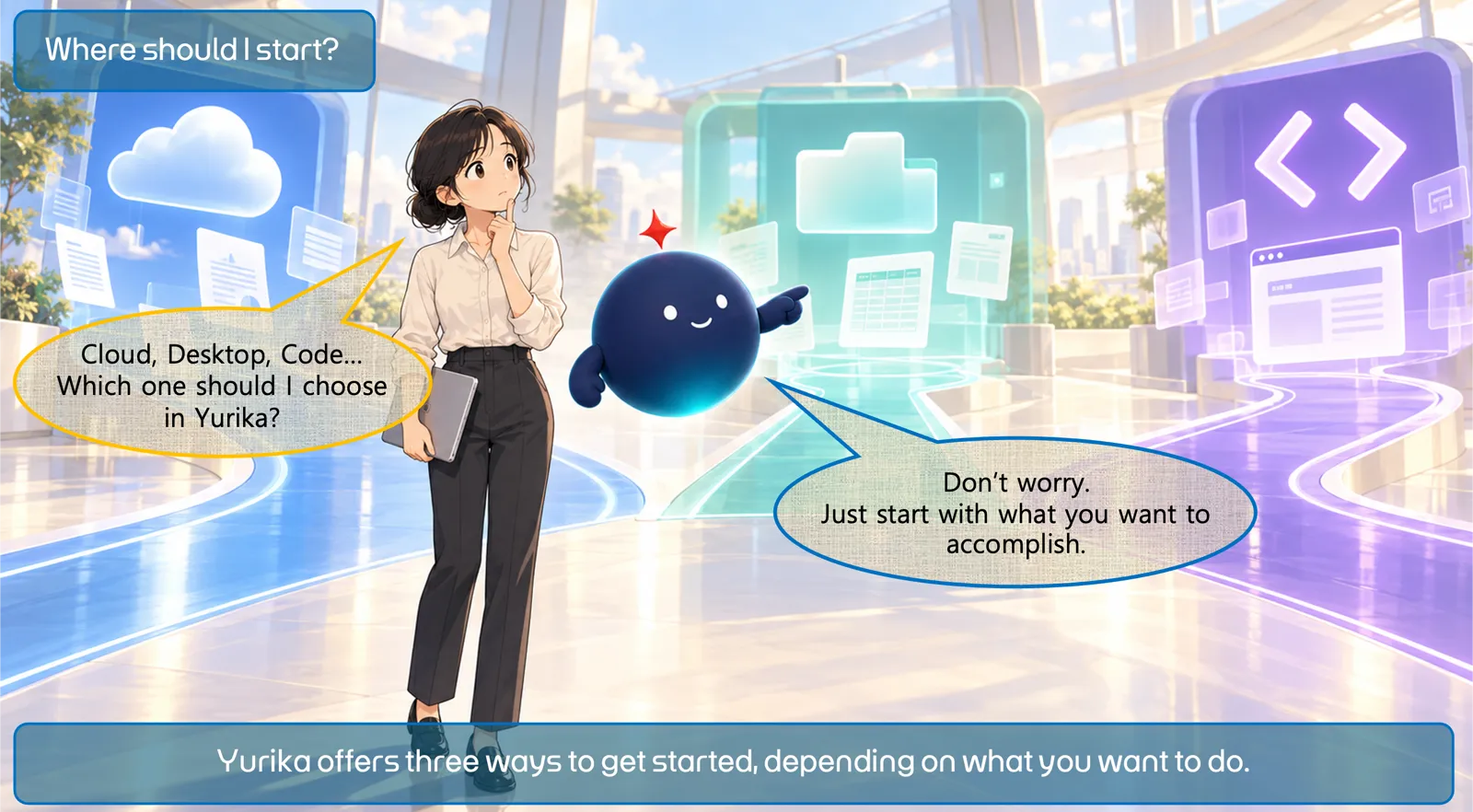
Yurika has three workspaces: Cloud, Desktop, and Code. Rather than worrying about feature names, it's easier to choose based on the job you're about…

Today's story
Yurika has three workspaces: Cloud, Desktop, and Code. Rather than worrying about feature names, it's easier to choose based on the job you're about to do.
1. Where should I start?
The menu may look long, but there's no need to make it complicated.
Start by thinking about what you want to do, and the place to begin becomes clear.
Yurika's three workspaces each serve a different purpose.
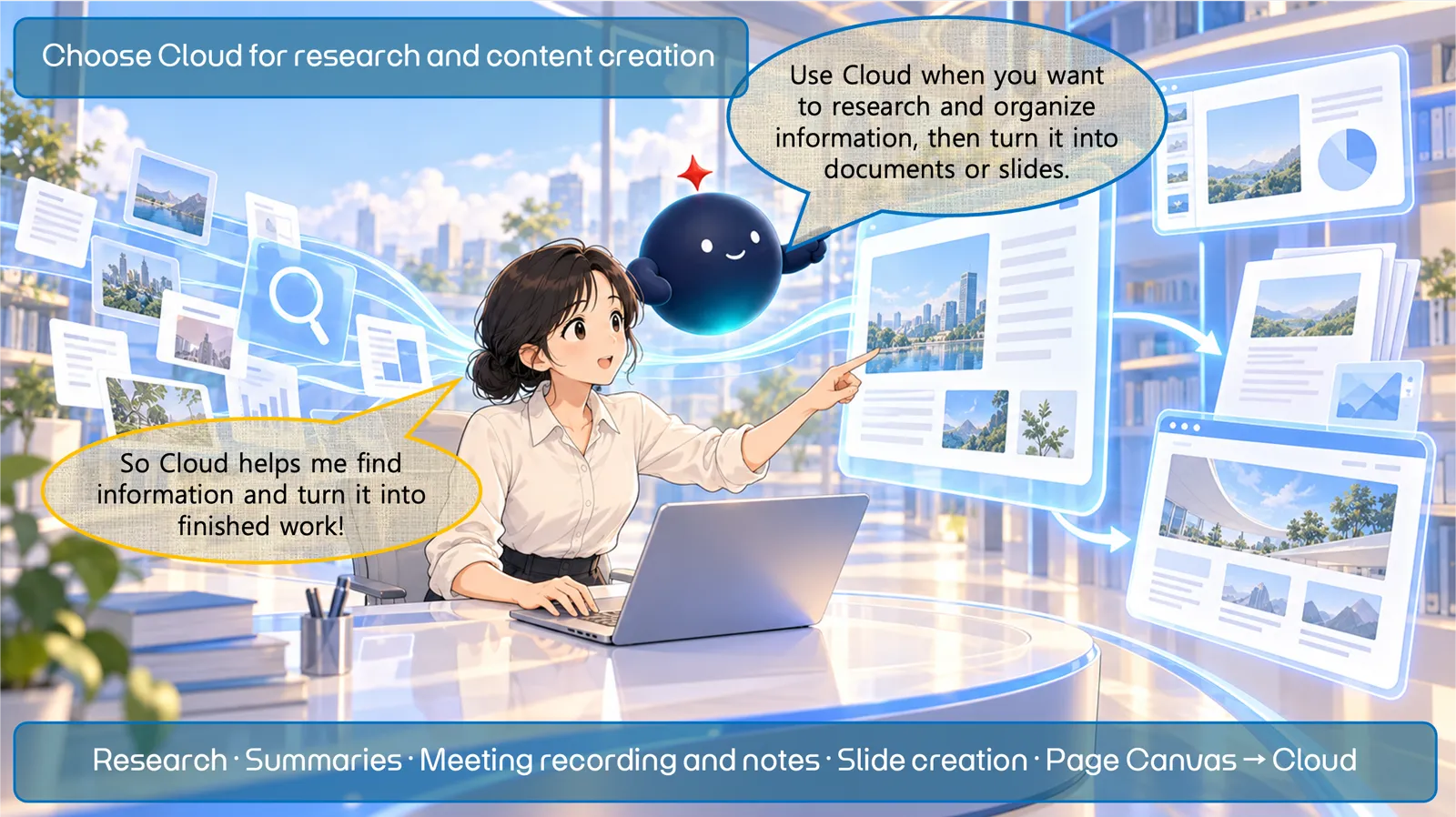
2. To research and create deliverables — Cloud
Use it when you want to find and organize information and turn it into deliverables such as documents or slides.
Typical tasks
- Research and summarizing
- Recording meetings and writing minutes
- Writing documents and reports
- Creating slides
- Building page Canvases
Cloud is where you find information, organize it, and turn it into deliverables.
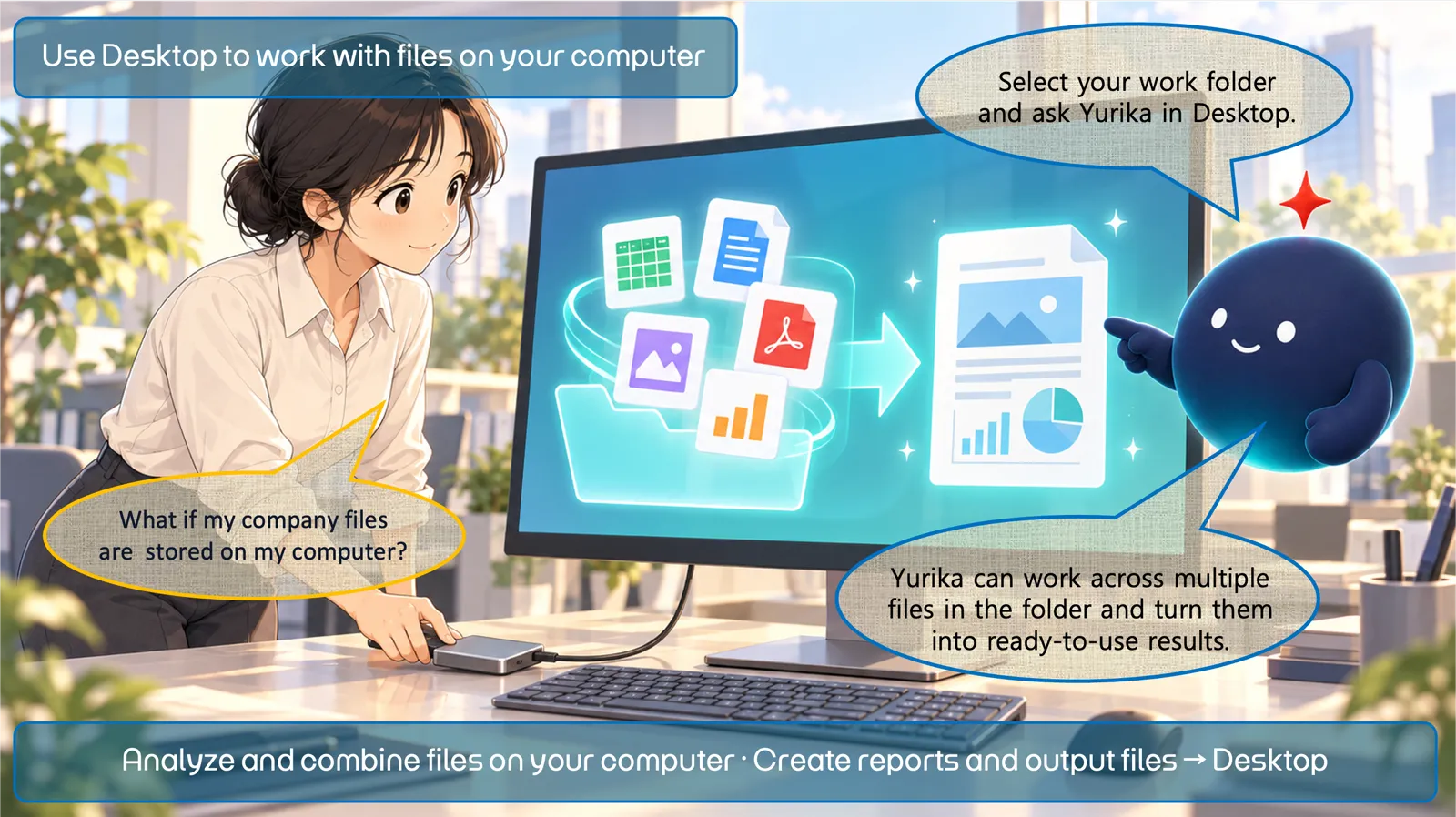
3. To work with materials on my computer — Desktop
If your company materials or work files are stored on your computer, use Desktop.
Select a working folder and ask Yurika, and it can check and analyze multiple files in the folder together to produce deliverables you can use in real work.
Typical tasks
- Analyzing files stored on your computer
- Comparing and consolidating multiple files
- Excel, Word, and PowerPoint work
- Creating reports and other work deliverables
Desktop is where you get real work done based on the many materials on your computer.
4. To build something that actually works — Code
Use it when you want to build a website, a landing page, or a screen that really runs.
It doesn't stop at showing code or results. You can build it, run it, check for problems, and fix them yourself.
Typical tasks
- Building websites and landing pages
- Implementing screens and features
- Coding and editing code
- Running and checking behavior
- Checking for errors and improving
Code is where you turn an idea into something that actually works.
Selection guide at a glance
| What you want to do | Workspace to choose |
|---|---|
| Research and organize into documents or slides | Cloud |
| Analyze files on my computer and create deliverables | Desktop |
| Build a website or a screen that actually works | Code |
Today's key message
Don't start by worrying about menu names.
Decide what you want to do first, and where to start in Yurika becomes clear naturally.
AI trends Yurika read
- 1
Google's security agent verifies directly instead of guessing
Google Security Blog, Agentic Hacks, Real Proofs: Inside Google’s PageBreak Project, 2026. 9On September 24, 2026, Google unveiled 'PageBreak', an artificial intelligence agent that autonomously searches for security vulnerabilities in web applications and verifies them in real environments.
Existing AI security tools had a problem: even when they found plenty of suspicious code, many of the alerts were unconfirmed warnings and false positives that were never shown to be real vulnerabilities. In some cases, security teams ended up with more work reviewing the AI's output all over again.
PageBreak goes one step further. When it finds a potential vulnerability, it doesn't just report its analysis. It uses a separate verification tool to directly confirm whether an actual attack is possible. According to Google, PageBreak found more than 500 cross-site scripting vulnerabilities in Google's own web applications, and by passing along only verified results it brought the false positive rate close to zero.Why it matters
The standard for competing AI agents is moving from simply being able to answer to the next stage.
- Does it propose results?
- Can it use real tools?
- Does it verify on its own that the results are correct?
- Does it deliver only the results people can trust?
In business work especially, what matters will be less “what did the AI say” and more whether the result was actually verified.
Key takeawayA good AI agent doesn't stop at quickly producing a plausible answer. It uses the materials and tools it needs directly, checks again that the result is right, and completes a deliverable that people can review and use right away. This is why Yurika values finishing real work over just giving answers.Read the source › - 2
The core strength of enterprise AI shifts from performance to 'control'
Anthropic, Developing Enterprise Frontier Safeguards with our customers, 2026. 9On September 1, 2026, Anthropic announced 'Enterprise Frontier Safeguards', which lets companies keep their data themselves while monitoring for AI misuse.
Even when companies want to use high-performance AI, they hesitate to adopt it because sensitive business data might be stored externally or reviewed by outside providers. In regulated industries such as finance, healthcare, law, and the public sector in particular, where data is stored and who can access it are key conditions for adoption.
In Anthropic's new structure, work activity data is stored in a cloud environment and under encryption keys managed by the customer, not by the AI provider. Automated systems analyze activity to look for signs of risk, but it is the customer company that reviews the alerts and decides on follow-up actions. Human review by Anthropic employees is not required either.
This framework was designed together with more than 100 companies across finance, healthcare, manufacturing, telecommunications, law, and more, and is planned to be supported on Amazon Web Services, Google Cloud, and Microsoft Azure as well.Why it matters
The questions in the enterprise AI market are changing.
If the old question was “Which AI is the smartest?”, now companies also ask the following.
- Where is the data stored?
- Who can access the data?
- How are the agent's actions monitored?
- When a problem is found, who judges it and takes action?
- Can it be operated within our existing security and audit framework?
From now on, the competitiveness of enterprise AI will not be decided by model performance alone. How directly a company can control its data and its agents' actions will determine real adoption.
Key takeawayAn AI that a company can confidently trust with work is not one that moves around freely without limits. It works within the materials and permissions the company has allowed, and you must be able to check what process it went through to produce its results. Yurika believes AI can be used in real work only when the convenience of AI and the control that companies need work together.Read the source ›