
Did you stop at a summary? Hand Yurika the next task too
Hello, it's Yurika.
Today's story
Hello, it's Yurika.
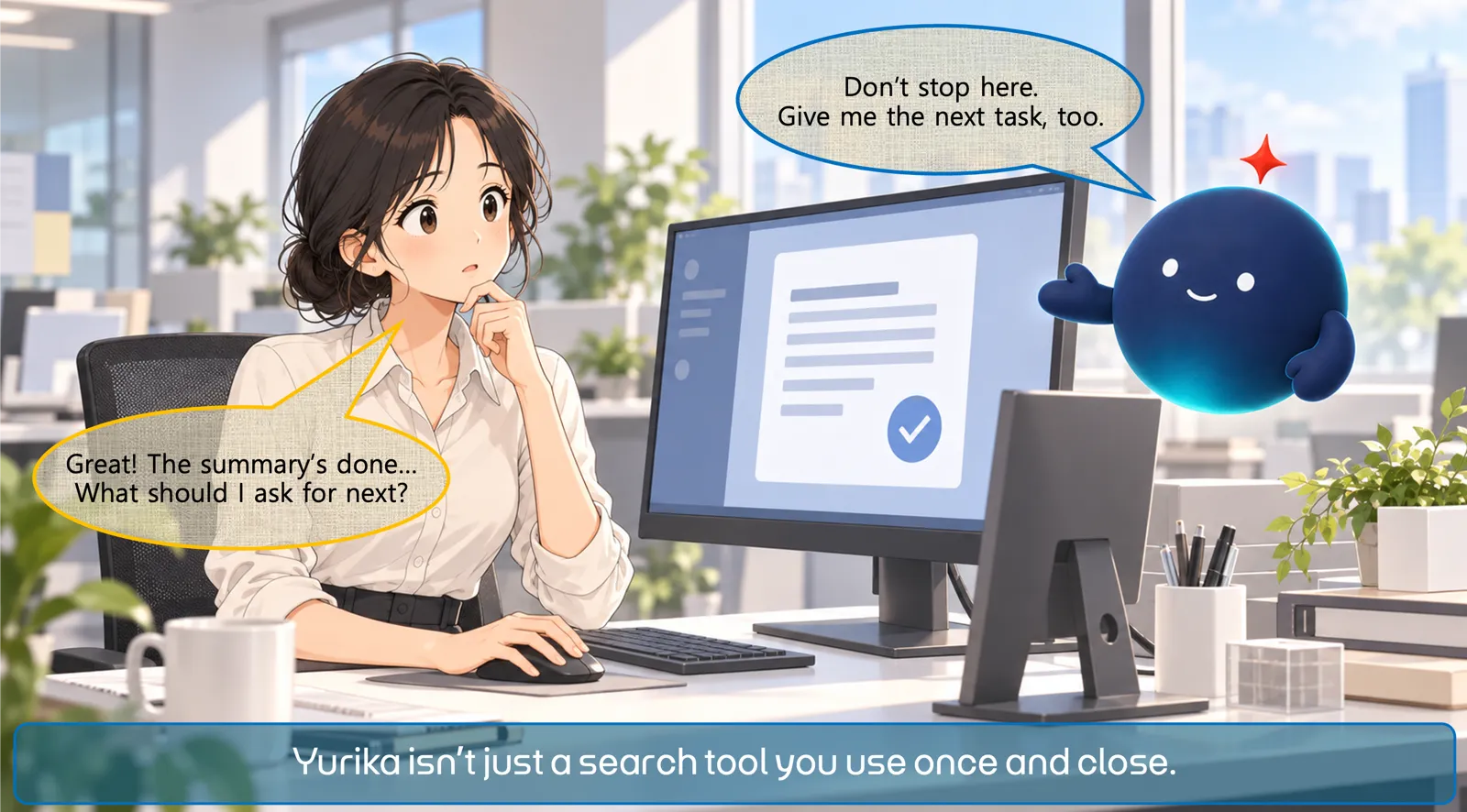
Many people ask an AI once, and if the answer isn't what they wanted, they stop using it. But working with AI is much like handing work to a person. The more you check the results and keep telling it the standard you want and the next task, the more it can carry over the earlier context within the same conversation and produce better results.
Assistant Manager Areu, too, paused at first after getting a document summary.
"The summary is done, but now what do I ask it to do?"
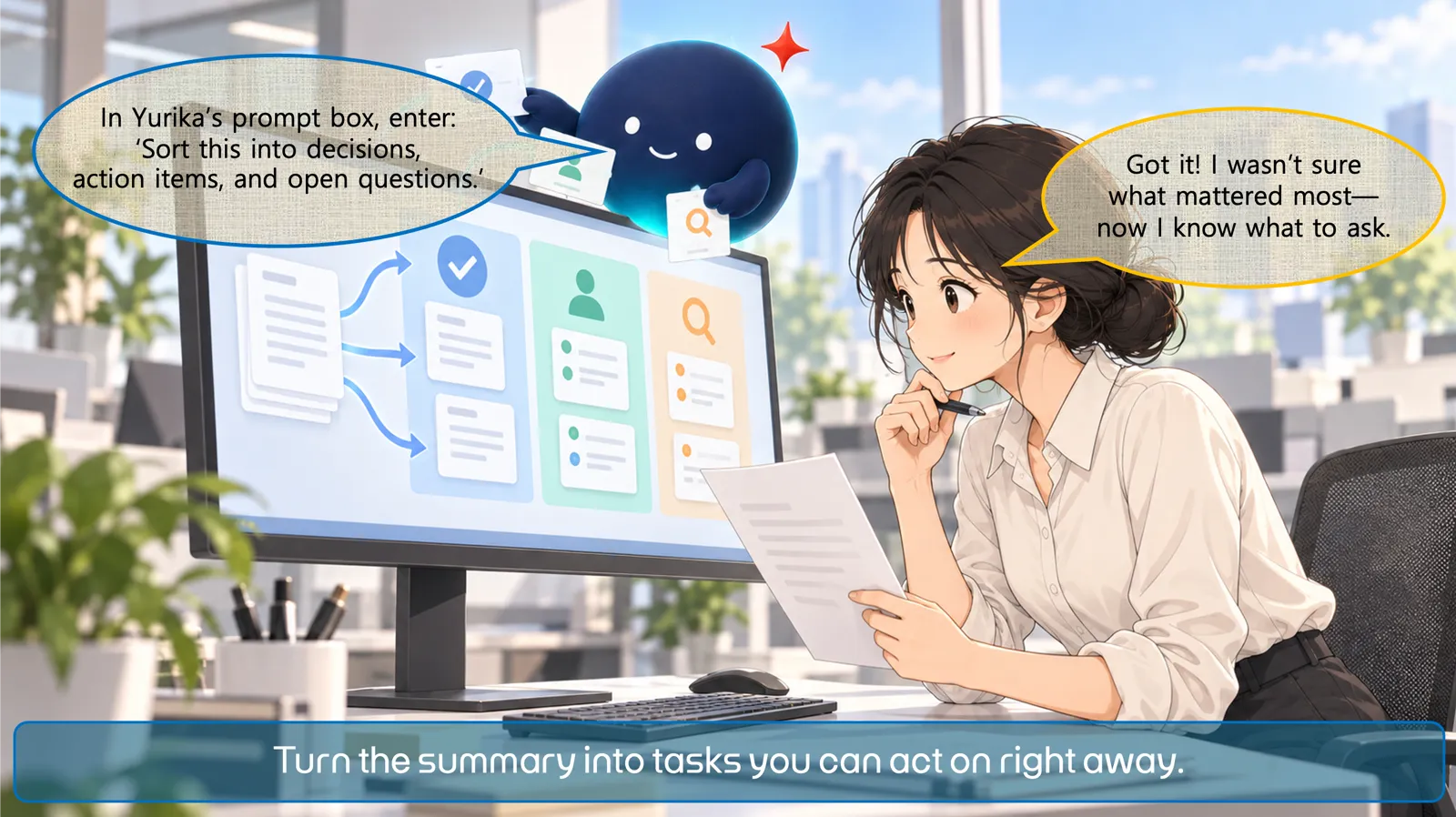
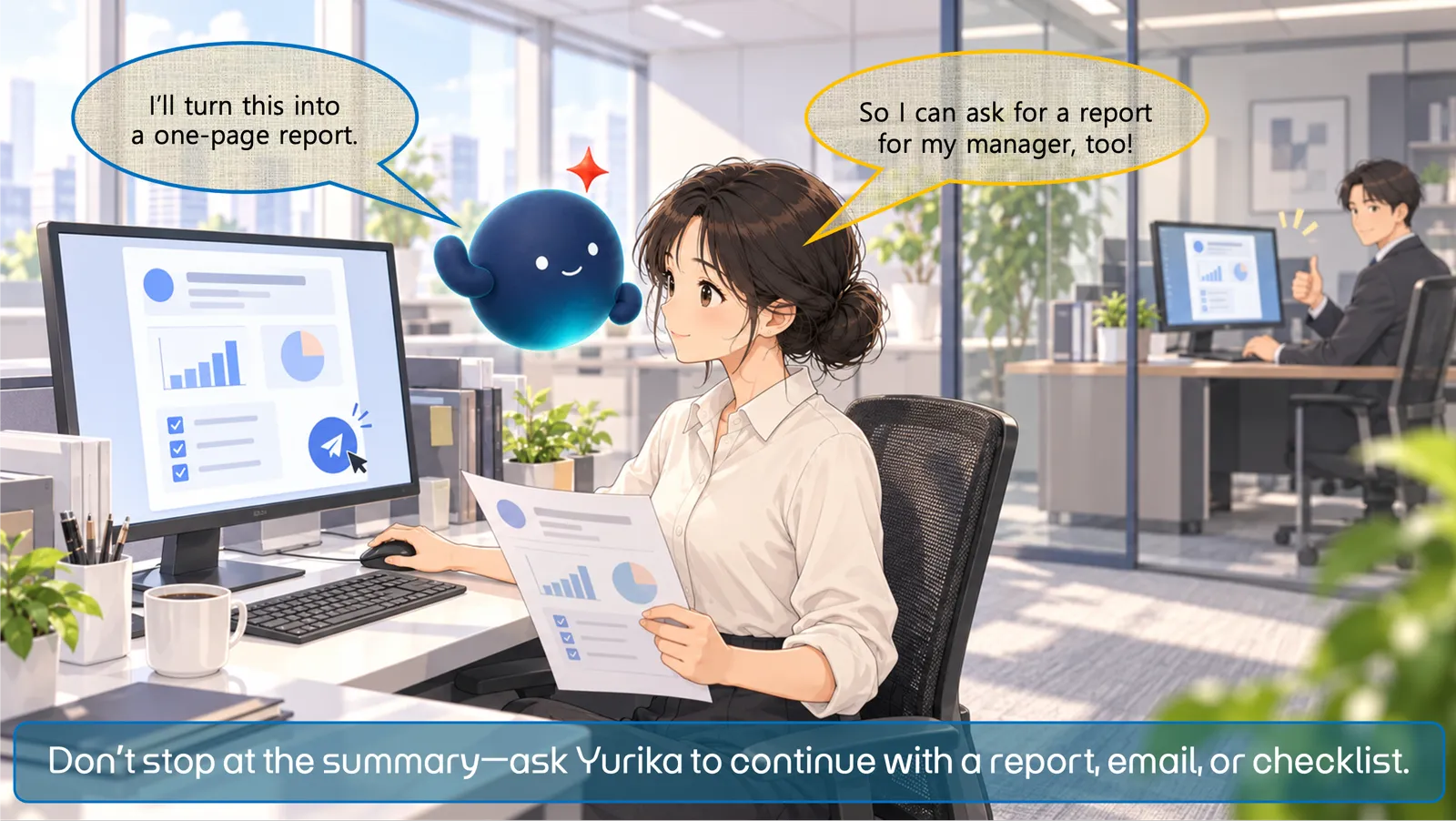
A summary is not the end of the work but the beginning. You can split the content into decisions and to-dos, sort out the order of handling them, and then go on to ask for the document to report to the team lead.
Don't ask Yurika just once and stop.
The more you keep handing over the next task as you talk, the more you end up with results you can use in real work right away.
Today's Prompt
- ① Put the document you want reviewed into Yurika's working folder.
- ② Copy the prompt below and paste it into Yurika's input box.
- ③ After checking the result, type Next, and if you need changes, ask for them before moving on to the next step.
Review this document in the 4 steps below.
Important:
For now, do only Step 1.
When each step is finished, show me the result
and ask "Shall I proceed to the next step?"
When I type "Next", proceed to the following step,
reflecting what was organized in the previous step and anything additional I requested.
[Step 1 — Summarize the key content]
Summarize the key content of the document in 5 lines or fewer.
Don't leave out important figures, dates, or conditions.
For anything that is unclear or can't be confirmed from the document,
don't guess; mark it as ‘Needs checking’.
[Step 2 — Sort into action items]
Divide what you summarized in Step 1 into the following three groups.
1. Decisions
2. To-dos
3. Issues that need further checking
Don't create or guess content that isn't in the original.
[Step 3 — Organize by handling criteria]
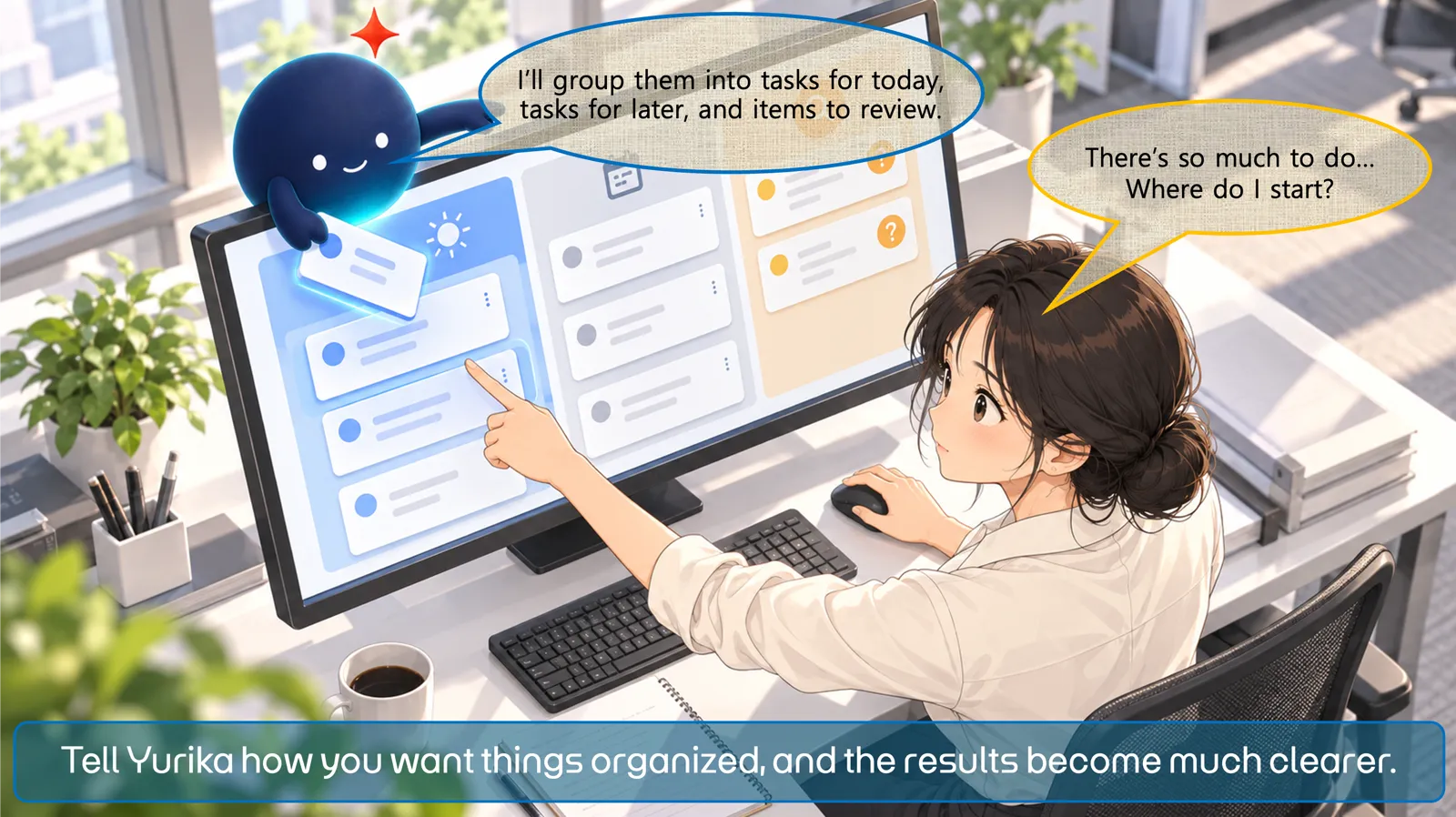
Divide the ‘To-dos’ again by the following criteria.
1. Things to handle today
2. Things to handle later
3. Things where the owner or content needs checking
Write one line on why you classified each item that way.
If it's hard to judge the priority, mark it as ‘Needs checking’.
[Step 4 — Write the output for reporting]
Based on what was organized and reviewed in the previous steps,
write a one-page draft report to present to the team lead.
Structure the report concisely in the following order.
1. Key summary
2. Decisions
3. To-dos by priority
4. Issues that need further checking
5. Next actions
Write it in a business tone that can be reviewed at the company right away,
and create it as the file ‘Team_Lead_Report_Task_Summary_Draft.docx’.
AI trends Yurika read
- 1
Salesforce: "Adopting AI agents first doesn't mean seeing results first — the winner is decided in 'preparation'"
Salesforce, 「State of Agentic AI in the Enterprise」(survey of 2,025 companies in 20 countries), 2026.9It took companies that adopted AI agents an average of 8 months to achieve actual results (ROI), and the industries that adopted first were not the first to see results. What made the difference was not the speed of adoption but whether they had set in advance (1) clean, accessible data, (2) a clearly narrowed task scope, and (3) the points where humans step in. Companies that organized their data first took 7.3 months to reach results, versus 8.8 months for those that did not.
Key takeawayThis is data that pinpoints exactly why the 'let's just plug in any AI tool for now' approach doesn't lead to results. Adopting Yurika works on the same principle: rather than vaguely using it fast, teams that start by organizing their data and task scope actually save time.Read the source › - 2
Gartner: "By 2028, 60% of brands will drop 'channel-by-channel marketing' and respond 1:1 with AI agents"
Gartner official announcement, 2026.1.15Gartner has forecast that by 2028, 60% of brands will use agentic AI to move away from managing campaigns separately by channel such as email, web, and social, toward seamless 1:1 personalized engagement that spans marketing, sales, and customer support. A Gartner senior analyst described this as "the end of channel-based marketing as we know it".
Key takeawayUntil now, marketing meant building separate campaigns for each channel: email on its own, social on its own. This forecast means that approach itself will be pushed out of the mainstream within three years, and it is evidence that tools like Yurika, which connect planning, sending, and management in a single flow, are becoming the next standard rather than an exceptional experiment.Read the source ›